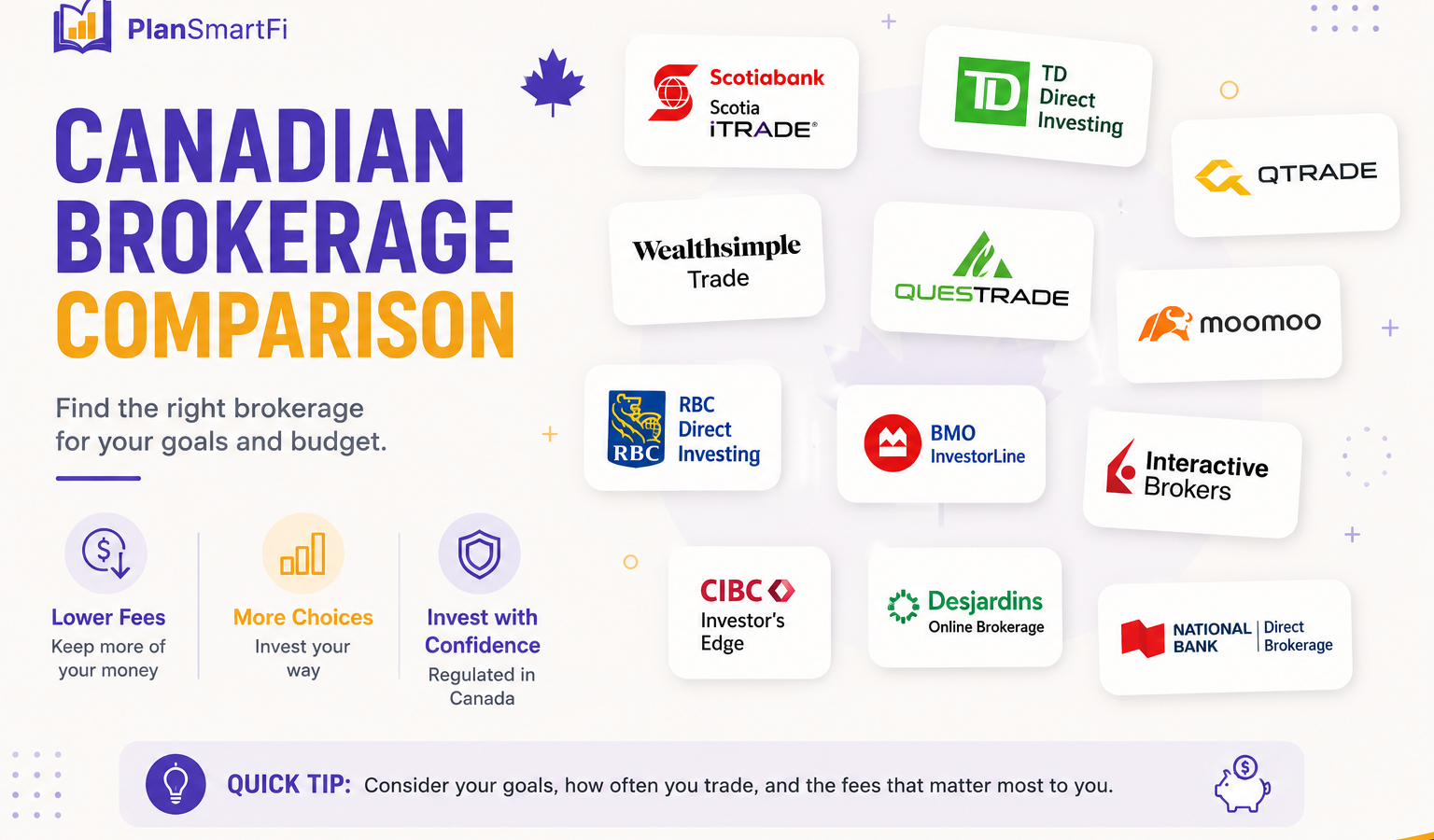
Canadian brokerage comparison for beginners. If you have decided to start investing in Canada, the first question you will run into is: where do I actually open an account? Canada’s brokerage landscape in 2026 is more accessible for beginners than it has ever been, with several platforms now offering $0 commissions and no account minimums. But more options can quickly turn into more confusion.
This comparison covers the major self-directed online brokerages available to Canadians, focusing on registered account support, fees, and who each platform tends to suit best. The goal is to help you make an informed decision, not to steer you toward any particular choice.
A few key terms
If you are new to investing in Canada, a quick primer on the account types that appear throughout this article:
- TFSA (Tax-Free Savings Account): Tax-free growth and withdrawals, for any goal. Any Canadian resident 18 or older with a Social Insurance Number (SIN) can open one.
- RRSP (Registered Retirement Savings Plan): Contributions reduce your taxable income today; withdrawals in retirement are taxed, ideally at a lower rate. Requires prior-year earned income to build contribution room.
- FHSA (First Home Savings Account): A newer account that combines RRSP and TFSA benefits specifically for first-time homebuyers. Contributions are tax-deductible; qualifying withdrawals are tax-free. Lifetime maximum of $40,000.
- RESP (Registered Education Savings Plan): Tax-sheltered savings for a child’s post-secondary education, with government grants (CESG) of up to $500/year per child.
Newcomers to Canada: You need a SIN to open any of these accounts. Get yours free at Service Canada. As a permanent resident, you can open a TFSA as soon as you become a Canadian tax resident. RRSP contribution room only starts accumulating after you file a Canadian tax return with earned income, so most newcomers will not have RRSP room in their first year. Confirm account eligibility with the institution based on your specific immigration status.
Regulation and investor protection
All reputable Canadian brokerages are regulated by the Canadian Investment Regulatory Organization (CIRO). Most are also members of the Canadian Investor Protection Fund (CIPF), which covers your securities and cash up to $1 million per account category if a member firm becomes insolvent. This protects you from brokerage failure only, not from investment losses. Always verify that any platform you choose is both a CIRO member and a CIPF member before opening an account.
Comparison table
The table below summarizes the major platforms as of early 2026. All fees are in CAD unless noted. Verify current details directly with each institution before opening an account, as fees and features can change.
A note on U.S. trades: nearly all platforms charge a currency conversion fee of approximately 1.5% when converting CAD to USD (or vice versa). This applies regardless of whether stock or ETF commissions are $0. Some platforms allow you to hold USD inside registered accounts to avoid repeated conversions; check the footnotes below.
| Brokerage | TFSA | RRSP | FHSA | RESP | Non-Reg. | Stock Trades1 | Inactivity Fee | Account Min. |
|---|---|---|---|---|---|---|---|---|
| Wealthsimple Trade | Yes | Yes | Yes | Yes | Yes | $0 | None | $0 |
| Questrade | Yes | Yes | Yes | Yes | Yes | $0 | None | $0 |
| Qtrade Direct Investing | Yes | Yes | Yes | Yes | Yes | $02 | $25/quarter3 | $0 |
| TD Direct Investing | Yes | Yes | Yes | Yes | Yes | $9.99 (50 free/yr) | Varies | Varies |
| RBC Direct Investing | Yes | Yes | Yes | Yes | Yes | $9.95 | Varies | Varies |
| CIBC Investor’s Edge | Yes | Yes | Yes | Yes | Yes | $6.95 | Varies | Varies |
| Scotia iTRADE | Yes | Yes | Yes | Yes | Yes | $9.99 ($4.99 active4) | $25/quarter5 | $0 |
| Interactive Brokers (IBKR) | Yes | Yes | Yes | No | Yes | From ~$0.01/share (min. ~$1.49) | None | $0 |
| National Bank Direct Brokerage | Yes | Yes | Yes | Yes | Yes | $0 | None | $06 |
| moomoo Financial Canada | Yes | Yes | No | No | Yes | From ~$0.015/share (CAD) | None | $0 |
2 Qtrade moved to $0 commissions for stocks, ETFs, and mutual funds effective October 28, 2025 (confirmed via official Qtrade press release). Some third-party comparison sites still show the prior $8.75 standard rate; verify the current pricing directly at qtrade.ca/pricing before opening an account. Options trades are $0.75/contract with no base fee. A separate $15/quarter fee may apply to USD-registered accounts (RRSP/TFSA in USD); FHSA and CAD accounts are not subject to this fee.
3 Qtrade’s $25/quarter inactivity fee applies in limited circumstances. It is waived for most account types, including all registered accounts (TFSA, RRSP, FHSA, RESP), and for accounts with $25,000+ in assets or at least one qualifying trade per quarter.
4 Scotia iTRADE’s $4.99 active trader rate applies to clients making 150 or more trades per quarter.
5 Scotia iTRADE’s $25/quarter inactivity fee applies to non-registered accounts with balances under $10,000 and no recent trades. Registered accounts (TFSA, RRSP, FHSA, RESP) are exempt from this specific fee; however, separate annual registered account fees may apply.
6 National Bank Direct Brokerage’s account minimum is often $0 for registered accounts (TFSA, RRSP, FHSA, RESP) and non-registered accounts; however, minimum balance requirements can vary by product or promotion. Confirm current requirements directly at nbdb.ca before applying.
Quick start for newcomers and first-time investors
- Get your SIN first. You need a Social Insurance Number to open any registered account. Apply free at Service Canada.
- Open a TFSA. The TFSA is the most flexible starting point: no income requirement, no tax on growth or withdrawals, and you can use it for any goal. Wealthsimple and Questrade both support mobile sign-up in around 15 minutes with no minimum deposit.
- Check CRA My Account after your first tax filing. Your official TFSA and RRSP room is confirmed by CRA, not by your brokerage. Log into CRA My Account after filing your first Canadian return to see your exact room before contributing.
How to choose: a decision framework
There is no universally “best” brokerage for every Canadian investor. The right fit depends on your specific situation. A few questions that tend to narrow the field:
Are you a newcomer or first-time investor who wants to keep things simple? Wealthsimple and Questrade both offer $0 commissions, no account minimums, and streamlined mobile onboarding that often takes under 15 minutes. Either can be a sensible starting point for someone opening a first TFSA.
Do you plan to hold a lot of U.S.-listed ETFs or stocks? Currency conversion fees can quietly add up to hundreds of dollars per year for investors who frequently buy U.S.-listed assets. Questrade and Qtrade both support USD-denominated registered accounts, which many investors use to avoid repeated conversions. IBKR offers among the lowest FX rates in Canada if you are an active cross-border trader.
Do you need a RESP? Most major platforms support it. IBKR and moomoo currently do not. If an RESP is part of your plan, rule those two out first.
Do you want strong research and charting tools? Qtrade and TD Direct Investing are frequently cited for platform quality. Wealthsimple’s standard platform is intentionally simplified, which is a feature for some and a limitation for others.
Do you already bank with one of the Big Six? Bank-affiliated brokerages (TD, RBC, CIBC, Scotia) integrate smoothly with existing chequing accounts and offer branch support. The trade-off is typically higher per-trade commissions compared to independent platforms.
Are you a more experienced or active trader? IBKR offers the widest global market access and competitive margin rates but requires comfort with a complex platform. Questrade Edge provides a strong desktop trading experience for active investors who want advanced tools without the full complexity of IBKR.
Platform-by-platform breakdown
Wealthsimple Trade
Widely regarded as Canada’s most beginner-friendly platform. The mobile app is polished and account opening takes minutes. Supports TFSA, RRSP, FHSA, RESP, and non-registered accounts with $0 commissions and no account minimum. Fractional shares are available for both Canadian and U.S. equities.
Key limitations: research and charting tools are basic; a 1.5% FX conversion fee applies to U.S. trades; USD-registered accounts are generally restricted to higher-tier plan holders. Wealthsimple also offers a separate robo-advisor and crypto product with different fee structures.
Questrade
Moved to $0 commissions on stocks and ETFs in early 2025. Options trades are $0.99/contract. Supports TFSA, RRSP, FHSA, RESP, RRIF, and non-registered accounts with no annual account fees. USD-registered accounts are available to all clients, making it a strong option for investors who regularly buy U.S.-listed assets and want to minimize repeated currency conversion costs. An advanced desktop platform (Questrade Edge) is available for more active traders.
Qtrade Direct Investing
Moved to $0 commissions on stocks, ETFs, and mutual funds effective October 28, 2025. Supports TFSA, RRSP, FHSA, RESP, RRIF, and non-registered accounts. Consistently earns high marks for platform quality, in-depth research tools, and customer service. A $15/quarter fee may apply to USD-registered accounts (RRSP/TFSA held in USD), but FHSA and CAD accounts are not subject to this. Options trades are $0.75/contract with no base fee, which is currently among the most competitive options pricing in Canada.
TD Direct Investing
Full registered account coverage (TFSA, RRSP, FHSA, RESP) with direct integration into TD banking. Standard commission is $9.99/trade; each client gets 50 free trades per year, and all TD ETFs trade commission-free without limit. TD Easy Trade is a separate mobile-only platform designed for beginners, supporting the same registered account types with a simpler interface. Higher standard commissions compared to independent platforms may make this less attractive for cost-focused investors who do not already bank with TD.
RBC Direct Investing
Supports TFSA, RRSP, FHSA, RESP, and non-registered accounts with seamless RBC banking integration. Standard commission is $9.95/trade. A solid choice for existing RBC customers; cost-focused investors will typically find better value elsewhere.
CIBC Investor’s Edge
The most cost-effective of the Big Six bank brokerages at a flat $6.95/trade. Supports TFSA, RRSP, FHSA, RESP, and non-registered accounts. TFSA and RESP accounts carry no annual fee regardless of balance. No commission-free ETF trading, but the per-trade rate is the lowest among major bank platforms.
Scotia iTRADE
Supports TFSA, RRSP, FHSA, RESP, and non-registered accounts. Standard commission is $9.99/trade, dropping to $4.99 for active traders making 150 or more trades per quarter. Over 100 ETFs are available commission-free. A notable feature is a practice (demo) trading account, which is uncommon among bank-affiliated platforms and useful for investors who want to test the experience before committing real money.
Fee caveats: an inactivity fee of $25/quarter applies to non-registered accounts under $10,000 with no recent trades (registered accounts are exempt). Annual registered account fees of $100 apply to RRSP and RRIF accounts unless you hold $25,000 or more in total assets, or have made at least 12 commissionable trades in the past year. Note that RESP accounts must be opened by phone rather than online, though the practice (demo) account is a good way to explore the platform before making that call. Customer service reviews from users have been mixed; verify the current platform experience directly if this matters to you.
Interactive Brokers (IBKR)
Best suited to experienced investors and active traders. Supports TFSA, RRSP, FHSA, and non-registered accounts for Canadian residents; RESP and locked-in plans are not currently available in Canada. TFSA and RRSP accounts require Canadian residency to open and maintain. Provides access to markets in over 150 countries with among the lowest FX conversion rates of any Canadian brokerage. The platform is feature-rich but complex, and the account opening process is more detailed than domestic-only platforms. Note that IBKR Canada places some restrictions on RRSP accounts not found elsewhere, including no withdrawals under the Home Buyers’ Plan or Lifelong Learning Plan, and limited support for in-kind transfers. Verify current terms on their website before applying.
National Bank Direct Brokerage
Offers $0 commissions on stocks and ETFs and supports TFSA, RRSP, FHSA, RESP, and non-registered accounts. Well-regarded among Quebec-based investors and available nationally. Worth considering if you already bank with National Bank or are looking for zero-commission trading with broad registered account coverage.
moomoo Financial Canada
A newer platform focused on advanced analytics and Level 2 market data at low per-share trading costs. Currently supports TFSA, RRSP, and non-registered accounts. FHSA and RESP are not yet available, which is a meaningful gap for first-time homebuyers and families saving for education. Regulated by CIRO and a CIPF member. As a newer entrant, account type coverage may expand; check the platform’s website for updates.
What “commission-free” actually means
A $0 commission on trades is accurate for most platforms listed above, for Canadian and U.S. equities and ETFs. A few other costs apply across most platforms regardless:
FX conversion fees. Approximately 1.5% on most platforms when converting CAD to USD. On a $10,000 U.S. purchase, that is $150. Holding USD inside a registered account (where the platform allows it) can reduce this cost for frequent U.S. equity buyers.
Options contracts. Even on $0-commission platforms, options trades typically carry a per-contract fee. Compare these specifically if options are part of your strategy.
Transfer-out fees. Moving an account to a different brokerage often triggers a fee of around $100 to $150. Many platforms reimburse this if you transfer in above a minimum threshold, but you typically need to request it explicitly.
Frequently asked questions
Can I have a TFSA at a brokerage and also at my bank?
Yes. You can hold TFSAs at multiple institutions at the same time. Your contribution room is a single total across all of them combined, not per account. CRA My Account shows your available room across all institutions. Opening a new TFSA elsewhere does not give you extra room.
Is my money safe at an online brokerage?
Yes, if the brokerage is a CIRO member and a CIPF member. CIPF covers your securities and cash up to $1 million per account category if the firm becomes insolvent. This is protection from brokerage failure only, not from investment losses. Always confirm both memberships on the brokerage’s website before opening an account.
What is the difference between a self-directed account and a robo-advisor?
Self-directed: you choose what to buy and sell. Robo-advisor: the platform automatically builds and manages a portfolio for you, typically using low-cost ETFs, for an additional management fee on top of the underlying fund costs. Several platforms, including Wealthsimple and Questrade, offer both options under the same login.
Can I transfer my existing TFSA or RRSP to a new brokerage?
Yes. Registered account transfers between institutions are common. Use a direct registered transfer (rather than withdrawing and redepositing) to avoid triggering contribution room issues. Transfer-out fees from your current provider may be reimbursed by the receiving brokerage if you transfer in above their minimum threshold; confirm the terms before initiating.
Do I need to be a Canadian citizen to open a brokerage account in Canada?
Most brokerages require a valid SIN and Canadian residency. Permanent residents and some temporary residents may be eligible depending on their status. Eligibility rules vary by institution, account type, and province. Confirm directly with the brokerage if you are a newcomer, and check CRA’s guidance on TFSA eligibility for non-residents.
Educational content only. This article is for informational purposes and does not constitute financial, investment, or tax advice. It is not a recommendation to open any specific account or use any particular platform. Brokerage fees, account features, and eligibility rules change frequently; always verify current information directly with each institution. Registered account rules may vary depending on your province and immigration status. If you are a newcomer, confirm residency eligibility with CRA before contributing to registered accounts.