Affiliate disclosure: This post contains affiliate links. If you open an account through a link on this page, PlanSmartFi may earn a commission at no extra cost to you.
This post is for educational purposes only. PlanSmartFi is not a financial advisor. Always do your own research and consider speaking with a licensed financial professional before making any financial decisions.
Index Funds in Canada: What They Are and How Beginners Can Get Started
Index funds Canada are one of the most talked-about tools in personal finance, and for good reason. They are low-cost, broadly diversified, and do not require you to pick individual stocks or follow the market closely. For many Canadians who are just starting to invest, they are a common first step.
This post explains what index funds are, how they differ from other investment types, and what the process of getting started looks like in Canada.
What Is an Index Fund?
An index fund is a type of investment that tracks a market index. A market index is simply a list of companies or assets grouped together to represent a segment of the market. Some well-known examples include:
- S&P 500 — tracks 500 large U.S. companies
- S&P/TSX Composite — tracks large Canadian companies listed on the Toronto Stock Exchange
- MSCI World Index — tracks large and mid-size companies across developed markets globally
When you invest in an index fund that tracks the S&P 500, you are not betting on one company. You are buying a small slice of all 500 companies in that index at once. If the index goes up, your investment goes up. If it goes down, your investment goes down. The fund simply follows the index, it does not try to beat it.
This is what makes index funds different from actively managed funds, where a portfolio manager picks and trades investments in an attempt to outperform the market. Research consistently shows that most actively managed funds underperform their benchmark index over the long run, particularly after fees.
ETFs vs Index Mutual Funds: What Is the Difference?
In Canada, index funds are available in two main forms: exchange-traded funds (ETFs) and index mutual funds. Both can track the same index, but they work differently.
| Feature | Index ETF | Index mutual fund |
|---|---|---|
| How you buy it | Through a brokerage, like a stock | Directly through a bank or fund provider |
| Minimum investment | Price of one unit (often under $50) | Often $500 or more to start |
| Trading | Trades throughout the day | Priced once per day after market close |
| Fees (MER) | Typically very low (0.05% to 0.25%) | Can vary widely (0.20% to 2%+) |
| Automatic contributions | Requires manual purchase | Often available automatically |
ETFs are the more commonly discussed option among Canadian investors today, largely because of their lower fees and flexibility. Index mutual funds can still be a reasonable option in certain situations, particularly when a bank plan includes them with automatic contribution features. Understanding both helps you evaluate what you are being offered.
What Is an MER and Why Does It Matter?
MER stands for Management Expense Ratio. It is the annual fee charged to manage a fund, expressed as a percentage of your investment. It is deducted automatically from the fund’s returns, so you never see a bill for it. But it still matters significantly over time.
Example: MER impact over 20 years on a $10,000 investment
Assumed annual return before fees: 6%
Low MER fund (0.20%): ~$30,900 after 20 years
High MER fund (2.00%): ~$22,800 after 20 years
Difference: ~$8,100 lost to fees alone
Index funds generally have much lower MERs than actively managed funds because they do not require a team of analysts making constant trading decisions. In Canada, many index ETFs carry MERs between 0.05% and 0.25%, while actively managed mutual funds commonly charge between 1.5% and 2.5%.
Canadian vs Global Index Funds
One question many Canadian beginners face is whether to invest in Canadian index funds, global index funds, or some combination. There is no single right answer, but here is a useful way to think about the difference:
| Type | What it covers | Consideration for Canadians |
|---|---|---|
| Canadian index fund (e.g. S&P/TSX) | Large Canadian companies | No currency risk, but heavily weighted toward financials and energy |
| U.S. index fund (e.g. S&P 500) | Large U.S. companies | Broad exposure, currency risk (USD/CAD fluctuation) |
| Global index fund (e.g. MSCI World) | Developed markets worldwide | Wide diversification, some currency exposure |
| All-in-one ETF | Mix of global stocks and bonds in one fund | Simple, diversified, popular with Canadian beginners |
All-in-one ETFs have become a popular starting point for Canadian beginner investors. They bundle a diversified mix of global index funds into a single fund with a single MER, removing the need to rebalance multiple holdings manually. They are not the only option, but they are one example of how index investing can be kept simple.
These are mentioned as examples only. What suits one person’s situation may not suit another’s. Doing your own research and, if needed, speaking with a licensed financial advisor is always worthwhile before putting money to work.
TFSA vs RRSP for Index Investing
In Canada, index funds can be held inside registered accounts, which affects how your returns are taxed. The two most commonly used registered accounts for this purpose are the TFSA and the RRSP.
| Feature | TFSA | RRSP |
|---|---|---|
| Tax on contributions | No deduction (contributed with after-tax dollars) | Tax deduction in the year you contribute |
| Tax on growth | Tax-free | Tax-deferred (taxed on withdrawal) |
| Tax on withdrawals | None | Taxed as income |
| Withdrawal flexibility | Withdraw anytime, room restored next calendar year | Designed for retirement; early withdrawal has tax consequences |
| Best suited for | Most goals, including medium and long term | Retirement savings, particularly for higher earners |
Many Canadians start with a TFSA for index investing because of its flexibility. Gains grow tax-free and you can withdraw without penalty. The RRSP tends to become more attractive as income rises, because the tax deduction on contributions is worth more at a higher marginal tax rate. Both accounts can hold index ETFs and index mutual funds.
Dollar-Cost Averaging: Investing Without Trying to Time the Market
Dollar-cost averaging means investing a fixed amount at regular intervals, regardless of what the market is doing. Instead of trying to find the perfect moment to invest a lump sum, you invest consistently over time.
Example: $200/month invested consistently
When prices are high, your $200 buys fewer units.
When prices are low, your $200 buys more units.
Over time, this smooths out the impact of market volatility on your average purchase price.
For most beginners, dollar-cost averaging removes the paralysis of trying to decide when to invest. It turns investing into a habit rather than a decision. Many Canadian investors set up a recurring contribution to their TFSA or RRSP on payday and invest that amount into their chosen fund each month.
How to Get Started in Canada
The general steps most Canadian beginners follow when starting with index funds:
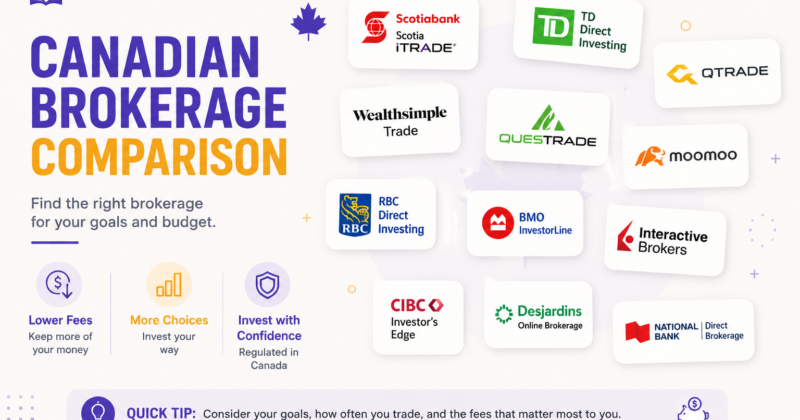
- Open a brokerage account. To buy index ETFs, you need a brokerage account. Several Canadian platforms offer commission-free ETF purchases, which means you are not paying a fee each time you buy. Two options many Canadians use are Wealthsimple and Questrade, which allows you to buy ETFs for free.
- Open a registered account inside it. Most brokerages allow you to open a TFSA, RRSP, or FHSA within your brokerage account. Choosing the right account type for your goal matters before you invest.
- Decide on a fund or combination. Research index funds or all-in-one ETFs available on the Toronto Stock Exchange. Look at the MER, what index it tracks, and how it is structured.
- Make your first contribution and purchase. Transfer money into the account, then use it to buy your chosen fund. For ETFs, you search the ticker symbol and place a buy order.
- Set up a recurring contribution. Automating a monthly transfer and purchase takes the ongoing decision-making out of the process.
The mechanics can feel unfamiliar at first, but most Canadian brokerage platforms have beginner guides and support resources to walk you through the process.
Frequently Asked Questions About Index Funds in Canada
Can you lose money in an index fund?
Yes. Index funds follow the market, which means they go down as well as up. If the index your fund tracks drops significantly, the value of your investment drops with it. Over long periods, broad market indexes have historically trended upward, but past performance does not guarantee future results. Index funds are generally considered a long-term investment.
How much money do you need to start investing in index funds in Canada?
With index ETFs, you can start with as little as the price of one unit, which can be under $50 for some funds. Index mutual funds sometimes require a minimum initial investment, often $500 or more. The amount you need depends on the platform and fund you choose.
Are index funds good for beginners?
Many financial educators consider index funds a reasonable starting point for beginners because they offer broad diversification, low fees, and do not require active management or stock-picking decisions. That said, all investing carries risk and what works for one person may not be right for another. Doing your own research before investing is always worthwhile.
Is an index fund the same as an ETF?
Not exactly. An ETF is a structure, a way of packaging and trading a fund on a stock exchange. An index fund is a strategy, tracking a market index rather than actively picking investments. Many ETFs are index funds, but not all ETFs track an index, and not all index funds are ETFs. In Canada, the most commonly discussed beginner index investing option is an index ETF.
The Bottom Line
Index funds give Canadian beginners a way to invest in a broad slice of the market without needing to pick individual stocks, follow daily market news, or pay high management fees. They are not risk-free, and they are not the only way to invest. But for someone who wants to start investing simply and consistently, they are worth understanding.
The most important step is the first one: opening an account and making an initial contribution, however small. The habit of investing consistently tends to matter more than trying to find the perfect fund or the perfect moment to start.
Financial Disclaimer: The information in this post is for educational purposes only and does not constitute financial advice. PlanSmartFi is not a financial advisor. All investing involves risk, including the potential loss of principal. Always do your own research and consider speaking with a licensed financial professional before making any investment decisions.