Most budgets fail before the month is over, not because the person using them is bad with money, but because the budget was never built to fit their actual life.
If you have tried budgeting before and found yourself abandoning it by week two, you are not alone. The good news is that a budget does not have to be complicated or restrictive to work. It just has to be honest, realistic, and yours.
In this post I am going to walk you through exactly how to build a Canadian monthly budget from scratch, explain the most popular budgeting methods so you can pick what fits, and give you a free interactive template you can start using today.
Free resource: Download the PlanSmartFi Monthly Budget Template and fill it in as you read. It is a simple, interactive HTML file you can open in any browser, fill out, and print.
Why most budgets do not stick
The most common reason people abandon a budget is that it was built on assumptions rather than reality. They guessed at how much they spend on groceries, underestimated how often they eat out, and forgot to account for irregular expenses like car repairs or annual subscriptions.
A few weeks in, the numbers stop adding up and the whole thing gets tossed.
The fix is not discipline. It is a better starting point. A good budget starts with what you actually spend, not what you think you should spend. Once you have a real picture of where your money goes, you can make intentional choices about where it goes next.
Step 1: Know your take-home income
The first number you need is your actual take-home pay — what lands in your bank account after taxes, CPP contributions, and EI premiums have been deducted. If you are salaried, this is straightforward. If your income varies, use a conservative average based on your last three to six months.
Include all sources. If you receive the Canada Child Benefit (CCB), GST/HST credit, or any provincial benefits, add those in too. If you are on parental leave, your EI maternity or parental benefits count as income for budgeting purposes.
Some income sources Canadians often forget to include:
- Canada Child Benefit (CCB) — paid monthly, tax-free
- GST/HST credit — paid quarterly by CRA
- Ontario Trillium Benefit or other provincial credits
- RRSP Home Buyers’ Plan repayments you receive back
- Any side income, freelance work, or rental income (before tax)
Write your total monthly take-home income at the top of your budget. Everything else flows from that number.
Step 2: List your fixed expenses
Fixed expenses are the bills that stay roughly the same every month. They are the easiest to budget for because there is not much guesswork involved. Go through your last two or three bank or credit card statements and pull these out.
Common fixed expenses for Canadians:
- Rent or mortgage payment
- Car payment or lease
- Car insurance
- Home or tenant insurance
- Internet and phone plan
- Childcare or daycare fees
- Loan or minimum debt payments
- Streaming subscriptions (Netflix, Spotify, etc.)
- Gym membership
Add these up. This is your fixed expense floor — the minimum you spend every month before you buy a single coffee or bag of groceries.
Step 3: Track your variable expenses
Variable expenses are where most budgets underestimate. These are the day-to-day costs that fluctuate: groceries, gas, dining out, household supplies, clothing, kids’ activities, personal care, and everything in between.
Rather than guessing, look at what you actually spent last month. Pull up your bank statements or credit card transactions and sort spending into categories. It takes about 20 minutes and will likely surprise you — most people underestimate their grocery and restaurant spending by a significant margin.
Once you have last month as a baseline, you can set realistic targets for each category. The goal is not to cut everything down to zero. It is to be intentional about where you want your money to go.
Step 4: Pay yourself first — savings before spending
Before you divide up the rest of your money between groceries and takeout, set your savings aside first. This is what paying yourself first means: you treat savings like a non-negotiable bill, not an afterthought.
For Canadians, registered accounts are the most tax-efficient place to save. The three main ones to consider are:
- TFSA (Tax-Free Savings Account): Growth and withdrawals are completely tax-free. A great default starting place for most Canadians. Open a TFSA with Wealthsimple.
- RRSP (Registered Retirement Savings Plan): Contributions reduce your taxable income now. Ideal if you are in a higher tax bracket. Open an RRSP with Questrade.
- FHSA (First Home Savings Account): If you are saving for a first home, this account gives you a tax deduction on contributions and tax-free withdrawals for a qualifying home purchase. Open an FHSA with Wealthsimple.
You do not have to contribute large amounts to start. Even $50 or $100 a month into a TFSA builds a habit and lets your money start growing. The most important thing is that savings go in before you decide what is left to spend.
Step 5: Do not forget irregular expenses
One of the most common budget-killers is forgetting about expenses that do not show up every month. Your car insurance renewal, Amazon Prime membership, holiday spending, back-to-school costs, or a dental checkup can all throw a monthly budget into chaos if you have not planned for them.
The solution is a sinking fund. A sinking fund is a separate savings pot you contribute to each month for a specific future expense. For example, if you know your car registration and insurance renewal costs about $1,200 per year, you set aside $100 a month into a sinking fund so the expense does not catch you off guard.
Common sinking fund categories for Canadian families:
- Annual insurance renewals
- Car maintenance and repairs
- Holiday gifts and travel
- Back-to-school supplies
- Home maintenance
- Medical and dental (if not fully covered)
- Kids’ activities and registration fees
Even setting aside $25 to $50 a month per category adds up quickly and smooths out the bumps in your budget.
Choosing a budgeting method that fits your life
There is no single budgeting method that works for everyone. The best one is the one you will actually stick with. Here are the most popular approaches and who they tend to work best for.
The 50/30/20 rule
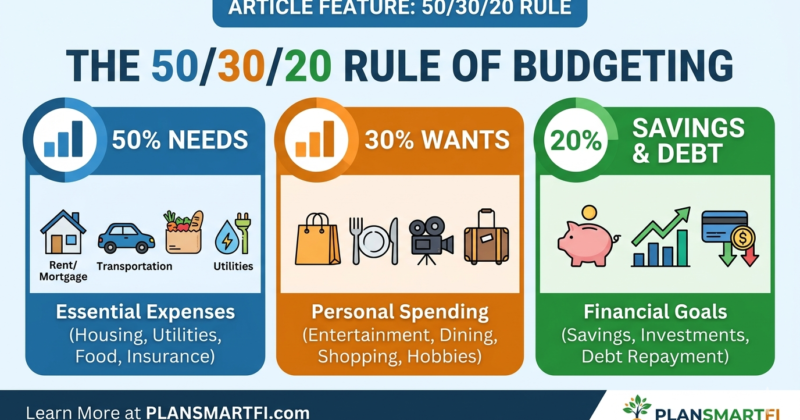
This is the simplest framework. You divide your take-home pay into three buckets: 50% goes to needs (rent, groceries, utilities, transportation), 30% goes to wants (dining out, entertainment, travel), and 20% goes to savings and debt repayment.
It is a good starting point, but it is worth noting that in many Canadian cities — especially Toronto and Vancouver — housing alone can eat more than 50% of take-home pay. If that is your situation, the ratios need adjusting. The 50/30/20 rule is a guide, not a rigid rule.
Zero-based budgeting
With zero-based budgeting, every dollar of your income gets assigned a job. Income minus all expenses, savings, and debt payments equals zero. Nothing is left unallocated. This method requires more effort upfront but gives you the most control and clarity.
It works well for people who want to be very intentional with their money or who are working through a period of tight finances.
The envelope method (cash stuffing)
You assign a cash budget to each spending category and physically (or digitally) put that amount in an envelope at the start of the month. When the envelope is empty, spending in that category stops. It creates a very tangible connection between your budget and your actual spending.
Many people adapt this digitally using separate savings accounts or sub-accounts for each category.
Pay yourself first
The simplest approach of all: automate your savings contributions at the start of every month and spend the rest however you like. This works well for people who find detailed category tracking overwhelming. You are not tracking every dollar, but you are making sure savings happen before anything else.
A simple Canadian monthly budget example
Here is what a basic monthly budget might look like for a Canadian household bringing home $5,000 a month after tax.
| Category | Amount | % of Income |
|---|---|---|
| Rent / mortgage | $1,800 | 36% |
| Groceries | $600 | 12% |
| Transportation (car + insurance) | $450 | 9% |
| Utilities + internet + phone | $250 | 5% |
| Dining out + entertainment | $350 | 7% |
| Subscriptions + personal care | $150 | 3% |
| Sinking funds (irregular expenses) | $150 | 3% |
| TFSA / savings | $500 | 10% |
| Debt repayment | $350 | 7% |
| Total | $4,600 | 92% |
The remaining $400 provides a small buffer for unexpected costs — which is important, because something unexpected almost always comes up.
This is just one example. Your numbers will look different depending on where you live, your family size, and your income. The point is not to copy this budget exactly but to see how the categories fit together.
Practical tips for sticking to your budget
Building the budget is the easy part. Sticking to it is where most people struggle. Here are a few things that make a real difference.
Review it weekly, not just monthly. A quick 10-minute check-in once a week helps you catch overspending early and adjust before the end of the month. Monthly reviews alone often come too late.
Give yourself a personal spending allowance. Give each person in your household a set amount of no-questions-asked spending money each month. This prevents budget resentment and gives you freedom within the plan.
Automate what you can. Set up automatic transfers to your savings accounts right after payday. If the money moves before you see it, you are much less likely to spend it.
Plan for fun. A budget that has no room for enjoyment is a budget you will abandon. Budget intentionally for things that matter to you, even if the amounts are small. It makes the whole plan feel sustainable instead of punishing.
Be flexible. Life happens. If you overspend in one category, you can adjust another rather than throwing the whole budget out. A budget is a plan, and plans change — that is normal.
Get the free budget template
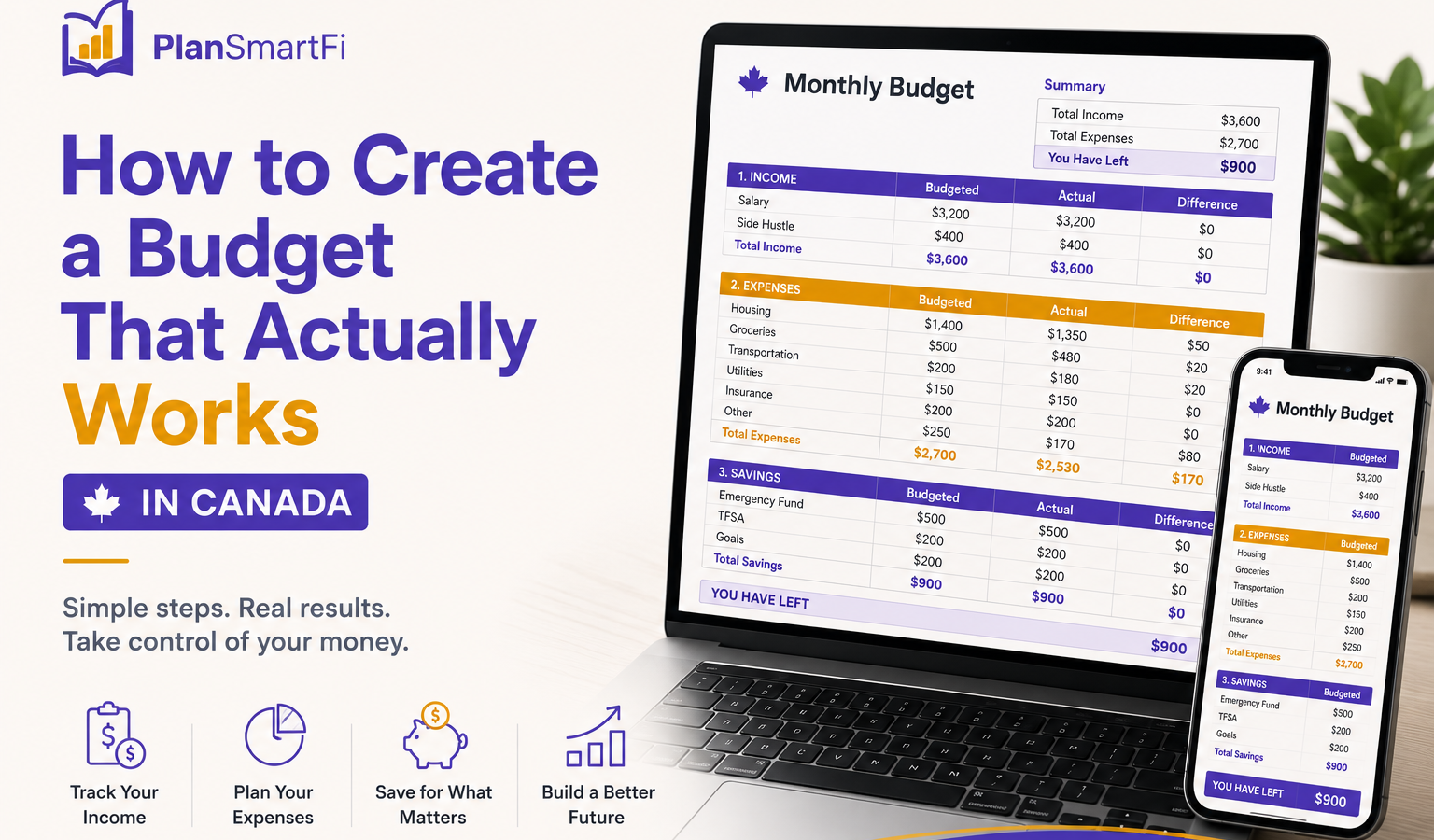
To help you get started, I built a free Canadian monthly budget template you can use right away. It is a simple, clean HTML file you can open in any browser on any device — no app download, no account required. Just fill in your numbers, and print or save when you are done.
It includes sections for income (including CCB and government benefits), fixed expenses, variable expenses, savings and registered accounts, irregular expenses, and a notes section for monthly reflections. There is also a live summary at the top that updates automatically as you fill it in.
Download it free: PlanSmartFi Monthly Budget Template (HTML) — open in any browser, fill it in, print or save as PDF.
If you are looking for a place to set up the savings side of your budget, both Wealthsimple and Questrade offer free TFSA, RRSP, and FHSA accounts with no minimum balance requirements — a good starting point if you are new to registered investing.
The bottom line
A budget is not about restriction. It is about clarity. When you know where your money is going, you can make choices that align with what actually matters to you — whether that is paying off debt faster, saving for a home, building a cushion for mat leave, or just spending less time worrying about money.
You do not need a perfect system. You just need one you will use. Start simple, adjust as you go, and give yourself credit for every month you show up and try.
If you have questions about any part of this or want to talk through how to structure your budget, drop a comment below. I am happy to help.
Disclaimer: The information in this post is for educational purposes only and does not constitute financial advice. Everyone’s financial situation is different. Please consult a qualified financial advisor before making decisions about your money.