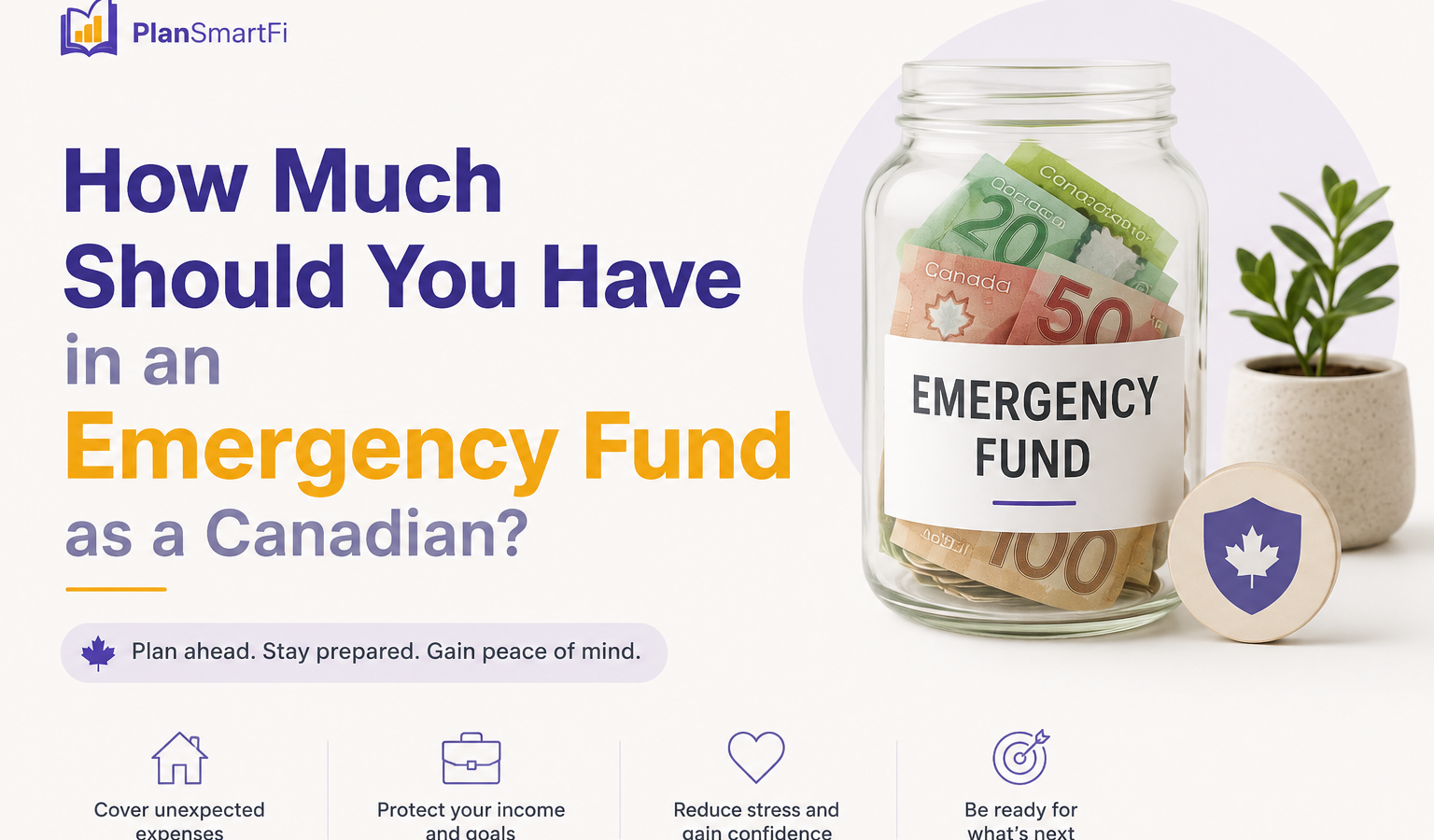
Ever been curious as to how much to have as emergency fund as a Canadian? An emergency fund is one of those things almost everyone knows they should have but few people feel confident they actually do. If you have ever had your car break down the same week a surprise bill arrived, you already know what it feels like to not have one. And if you are currently building yours from scratch, you might be wondering: how much is actually enough?
The honest answer is that it depends on your life. But there are some clear principles that can help you land on a number that is right for your situation and a realistic way to get there.
What an emergency fund is actually for
An emergency fund is a dedicated pool of savings set aside for genuine, unexpected expenses, the kind that would otherwise force you to take on debt or pull money from investments at the wrong time. It is not a general savings account, and it is not for planned expenses. It is specifically there for the moments life catches you off guard.
What counts as an emergency:
- Job loss or sudden reduction in income
- Unexpected medical or dental costs not covered by insurance
- Car repairs needed to get to work
- Emergency home repairs (a burst pipe, a broken furnace in January)
- A family emergency requiring last-minute travel
What does not count as an emergency:
- Holiday shopping
- A sale you do not want to miss
- Planned expenses you forgot to budget for
- A vacation
The reason the distinction matters is that dipping into your emergency fund for non-emergencies means it will not be there when you truly need it. Once you start treating it as a general backup account, the protection it provides disappears quickly.
The standard advice: three to six months of expenses
The most commonly cited guideline is to save three to six months of living expenses. This is a reasonable starting point, but it leaves a lot of room for interpretation and for most Canadians, the right number sits somewhere specific within that range depending on a few key factors.
Three months tends to be enough if you have a stable, full-time job with a strong likelihood of re-employment if you lost it, a dual-income household, no dependants, and low fixed monthly expenses.
Six months or more makes more sense if you are self-employed or a contract worker with variable income, you are the sole earner in your household, you have dependants such as children or a parent you help support, you work in a field with longer job search timelines, or you have a health condition that could affect your ability to work.
The goal is not to hit a specific number because someone told you to. The goal is to cover the most likely financial disruptions in your life without going into debt.
How to calculate your number
The most practical way to figure out your emergency fund target is to add up your essential monthly expenses — the ones you absolutely cannot skip and multiply by the number of months that feels right for your situation.
Essential monthly expenses to include:
- Rent or mortgage
- Groceries
- Utilities and internet
- Phone
- Transportation (car payment, insurance, gas, or transit pass)
- Minimum debt payments
- Childcare or essential prescriptions
- Any other non-negotiable bills
Notice what is not on this list: dining out, subscriptions, clothing, entertainment. Your emergency fund is sized around survival mode expenses, not your full current lifestyle. The idea is that if something went wrong, you would naturally cut back on the non-essentials. Your fund only needs to cover what you truly cannot cut.
As an example, if your essential monthly expenses add up to $3,200, a three-month emergency fund would be $9,600 and a six-month fund would be $19,200. Those numbers can feel overwhelming at first glance, which is why the next part matters.
Starting small is still starting
One of the most common reasons people never build an emergency fund is that the full target feels too far away to bother starting. But a smaller fund is infinitely better than no fund at all — and the first $1,000 is the most important milestone of the whole process.
A $1,000 emergency fund handles the majority of common financial surprises: a car repair, a dental filling, a broken appliance, an unexpected vet bill. It will not cover job loss, but it will stop smaller emergencies from turning into debt spirals. Getting to $1,000 first, as quickly as you can, is a meaningful and achievable first target.
From there, you build toward one month of expenses, then two, then three. Each milestone adds a real layer of protection even if you never reach six months.
Canadian-specific considerations
A few things about the Canadian context are worth keeping in mind when thinking about your emergency fund size.
Employment Insurance (EI) helps, but has a waiting period. If you lose your job, EI provides some income replacement, but there is a one-week waiting period before payments begin, and it takes time for your first payment to arrive. EI also only replaces a portion of your income up to 55% of insurable earnings, to a maximum. Your emergency fund needs to bridge that gap, especially in the early weeks.
Self-employed Canadians have less of a safety net. If you are self-employed, you can opt into EI for special benefits like parental leave, but you are not eligible for regular EI if your income drops. This means a larger emergency fund is especially important if you run your own business or work on contract.
The cost of living varies enormously across Canada. Three months of expenses in Halifax looks very different from three months of expenses in Toronto or Vancouver. Calculating your number based on your actual local costs, and not national averages is the only way to arrive at a figure that actually protects you.
Provincial health coverage helps but does not cover everything. While Canada’s public health care system covers many medical costs, there are still significant out-of-pocket expenses: dental work, prescription drugs, ambulance fees, vision care, and paramedical services like physiotherapy or mental health support. If you do not have a workplace benefits plan that covers these, they belong in your emergency fund calculation.
Where to keep your emergency fund
Your emergency fund has two jobs: stay safe and stay accessible. That means it should not be invested in anything that could drop in value right when you need it most, and it should not be locked away somewhere that takes days to access.
A high-interest savings account (HISA) is the most common and sensible home for an emergency fund. Look for one with no monthly fees and no minimum balance requirements. Many online banks and financial institutions in Canada offer competitive rates on savings accounts without the overhead of a traditional branch bank.
A few things to avoid when choosing where to hold your emergency fund:
- Investments (stocks, ETFs, mutual funds): Markets can drop significantly at exactly the moment a job loss or crisis hits. Locking your emergency money into something that might be down 20% when you need it defeats the purpose.
- GICs with fixed terms: Cashable GICs are fine, but non-redeemable GICs can leave you unable to access the money when you need it.
- Your chequing account: Keeping it mixed in with your everyday spending makes it too easy to spend gradually without realising it.
The sweet spot is a separate savings account that earns some interest, that you can transfer from within one to two business days, and that you do not look at every day. Out of sight enough to leave alone, accessible enough to use in a real emergency.
What if you have debt and no emergency fund?
This is one of the most common financial dilemmas Canadians face: you have credit card debt at a high interest rate, and you also have no emergency fund. Should you pay off the debt first, or build the fund?
The answer most financial educators land on is: do both, in a specific order. Start by building a small emergency buffer around $1,000 before aggressively paying down debt. The reason is practical: without any buffer, the first unexpected expense sends you straight back to the credit card, undoing your progress. A small fund breaks that cycle.
Once you have that initial cushion, shift your focus to high-interest debt. After that debt is cleared, build your full emergency fund to your three to six month target. The order matters because high-interest debt costs more the longer it sits, but a small buffer prevents you from making that problem worse during the process.
How long will it take to build?
This depends entirely on how much you can set aside each month. The most useful thing you can do is pick a specific monthly amount, even a small one, automate the transfer so it happens right after payday, and let time do the work.
Some rough timelines based on saving $200 a month:
| Target | Time at $200/month | Time at $400/month |
|---|---|---|
| $1,000 starter fund | 5 months | 2–3 months |
| $5,000 | 25 months | 12–13 months |
| $10,000 | 50 months | 25 months |
| $15,000 | 75 months | 37–38 months |
The numbers are not meant to be discouraging, they are meant to show that consistency over time does the heavy lifting. A $200 monthly contribution is less than $7 a day. Most people can find that somewhere in their budget if it becomes a priority.
One thing that helps: treat your emergency fund contribution like a bill. It goes out automatically, it is not optional, and it is not subject to negotiation with yourself on a slow month. That mindset shift from “I’ll save what’s left” to “savings come first”, is what separates people who build emergency funds from those who mean to.
The bottom line
There is no single right answer for how much you need, but there is a right process for figuring out your number. Start with your essential monthly expenses, multiply by the number of months that reflects your income stability and family situation, and work toward that target one automated transfer at a time.
If you are just getting started, aim for $1,000 first. It is achievable, it is meaningful, and it changes the way small financial surprises feel when they happen. From there, you build.
The goal of an emergency fund is not to have a large number sitting in an account. It is to give yourself the security to handle whatever comes without panic, without debt, and without derailing everything else you are working toward.
Disclaimer: The information in this post is for educational purposes only and does not constitute financial advice. Everyone’s financial situation is different. Please consult a qualified financial advisor before making decisions about your money.