Disclosure: This post contains links to Wealthsimple and Questrade. I may earn a commission if you sign up through these links, at no extra cost to you. I only recommend tools I believe are genuinely useful for Canadians.
If you have ever told yourself you will start investing “once you know more about it,” you are not alone. Investing can feel like a world with its own language, its own rules, and a steep cost of entry if you get it wrong. So most people put it off, sometimes for years.
The truth is that investing in Canada is more accessible than it has ever been, and you do not need to understand everything before you start. You just need to understand enough. This post is going to give you that foundation: what investing actually is, why it matters, which accounts to use in Canada, and how to take your first concrete step.
What investing actually means
At its most basic, investing means putting your money to work so it can grow over time. Instead of sitting in a savings account earning a small amount of interest, invested money has the potential to grow significantly through the returns generated by stocks, bonds, funds, or other assets.
The reason investing matters is inflation. Every year, the cost of living rises, which means the purchasing power of money sitting idle slowly shrinks. A dollar today buys less than a dollar did ten years ago. Investing is how you stay ahead of that erosion and build wealth over time rather than just preserving it.
The other reason investing matters is compounding. When your investments earn returns, those returns get added to your total balance and then they start earning returns too. Over time, this creates a snowball effect that becomes more powerful the longer it runs. Starting earlier, even with small amounts, consistently outperforms starting later with larger amounts.
What you are actually investing in
When most people talk about investing, they are talking about a few core types of assets.
Stocks are small ownership stakes in a company. When a company grows and becomes more valuable, its stock price rises and you benefit. Stocks have the highest long-term growth potential but also the most short-term volatility, meaning their value can go up and down significantly from year to year.
Bonds are essentially loans you make to a government or company in exchange for regular interest payments and the return of your original amount at the end of a set term. Bonds are generally more stable than stocks but grow more slowly.
ETFs (Exchange-Traded Funds) are one of the most beginner-friendly options available. An ETF is a single investment that holds a basket of many stocks or bonds at once. Instead of buying shares in one company, you buy a slice of hundreds or thousands of companies in one purchase. This built-in diversification reduces risk significantly compared to picking individual stocks, and ETFs typically come with very low fees. For most Canadian beginners, a simple ETF portfolio is the most practical and effective starting point.
Mutual funds work similarly to ETFs in that they pool money across many investments, but they are actively managed by a fund manager and typically carry higher fees. In Canada, mutual fund fees (called the Management Expense Ratio, or MER) are among the highest in the world, which is one reason many Canadians are moving toward low-cost ETFs instead.
Real estate is another asset class many Canadians think about when it comes to building wealth, whether that means buying a home, an investment property, or investing in REITs (Real Estate Investment Trusts, which let you invest in real estate through the stock market without buying physical property). It is a legitimate path, but it comes with its own set of considerations around financing, leverage, and carrying costs. If homeownership or real estate investing is on your radar, we cover that in more depth in the Home Buying section.
Before you invest: the order of operations
Before putting money into investments, it helps to have a few things in place first. This is not about being perfect before you start, it is about making sure investing does not create problems elsewhere in your finances.
A reasonable order to follow:
- Have a small emergency fund. Even $1,000 set aside means a surprise expense will not force you to sell investments at a bad time.
- Pay off high-interest debt. Credit card debt at 19 to 22% interest is almost impossible to outperform with investments. Paying it off is a guaranteed return.
- Start investing, even a small amount. Once the above are in reasonable shape, there is no need to wait for the perfect moment. Time in the market matters more than timing the market.
You do not have to have zero debt or a fully-funded emergency account before investing a single dollar. But having that basic foundation means your investments can actually stay invested, which is where the real growth happens.
The registered accounts every Canadian investor should know
One of the biggest advantages Canadian investors have is access to registered accounts which are accounts with special tax benefits that can dramatically improve your long-term returns. Understanding these accounts is one of the most important things you can do before you open a brokerage account.
TFSA – Tax-Free Savings Account
The TFSA is the most flexible registered account available to Canadians. Any money you earn inside a TFSA, whether through investment gains, dividends, or interest, is completely tax-free. You can withdraw the money at any time for any reason, and the room you withdraw gets added back to your contribution limit the following year.
In 2026, the annual contribution limit is $7,000. If you have never contributed to a TFSA and were 18 or older in 2009 when the account launched, your total accumulated room is $109,000. You can check your exact limit through your CRA My Account.
For most beginners, the TFSA is the first account to fill. The tax-free growth is valuable at any income level, and the flexibility to withdraw without penalty makes it well-suited to both long-term goals and medium-term ones.
RRSP – Registered Retirement Savings Plan
The RRSP is designed specifically for retirement savings. Contributions are tax-deductible, meaning they reduce your taxable income in the year you contribute. The investments inside grow tax-deferred, and you pay tax only when you withdraw, ideally in retirement, when your income and tax rate are lower.
The annual RRSP dollar maximum was $32,490 for the 2025 tax year and is $33,810 for the 2026 tax year, but your own RRSP deduction room may be different depending on earned income, pension adjustments, unused room and other CRA rules. The contribution deadline for deductions on a 2025 tax return was March 2, 2026, not March 1. Your latest CRA Notice of Assessment is a useful starting point for confirming personal deduction room.
The RRSP tends to be most valuable for people in higher tax brackets, since the deduction provides a larger upfront benefit. If you are early in your career or in a lower income year, maximising your TFSA first often makes more sense.
FHSA – First Home Savings Account
The FHSA is a newer account designed specifically for first-time home buyers. It combines the best features of the TFSA and RRSP: contributions are tax-deductible like an RRSP, and qualifying withdrawals for a first home purchase are tax-free like a TFSA. You can contribute up to $8,000 per year, with a lifetime limit of $40,000.
If you are saving toward a first home, the FHSA is one of the most tax-efficient tools available to you in Canada right now.
Which account should you open first?
For most Canadian beginners, this is a reasonable starting order: TFSA first for its flexibility and tax-free growth, FHSA second if homeownership is a goal within the next 15 years, and RRSP third or alongside the others once income is higher and the tax deduction becomes more valuable.
Where to actually open an investment account in Canada
Once you know which account type you want to open, you need to choose where to open it. In Canada, you have two broad categories: traditional banks and online brokerages.
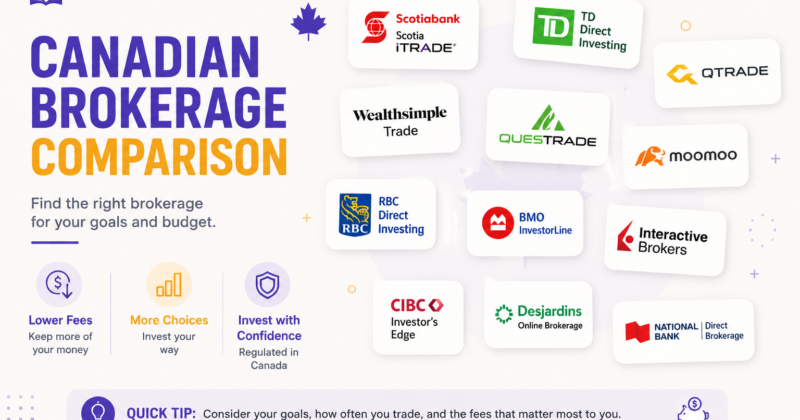
Traditional bank investment accounts (through RBC, TD, Scotiabank, BMO, or CIBC) are convenient if you already bank there, but they tend to come with higher fees, limited investment options, and staff who may steer you toward higher-cost products like mutual funds.
Online brokerages and robo-advisors have changed the landscape significantly. Two of the most popular options for Canadian beginners are:
Wealthsimple is a Canadian-built platform that offers two paths: Wealthsimple Invest, a robo-advisor that builds and manages a diversified portfolio for you automatically based on your risk tolerance, and Wealthsimple Trade, a self-directed platform where you can buy and sell ETFs and stocks yourself. Both offer TFSA, RRSP, and FHSA accounts with no minimum balance. For complete beginners who want a hands-off approach, Wealthsimple Invest is one of the simplest ways to start.
Questrade is a self-directed online brokerage well-suited to beginners who want a bit more control. ETF purchases are free (you only pay a small commission to sell), and the platform offers TFSA, RRSP, FHSA, and non-registered accounts. It has more features and flexibility than Wealthsimple Trade but a slightly steeper learning curve for absolute beginners.
Either platform is a solid starting point. The most important thing is that you open an account and make your first contribution; the choice between them matters far less than the act of getting started.
What to actually invest in as a beginner
This is where a lot of beginners get stuck. The account is open, money is sitting there, and now what?
For the vast majority of Canadian beginners, a simple all-in-one ETF is the most practical answer. These are single funds that hold a globally diversified mix of stocks and bonds in one purchase. You buy one ETF, and you are instantly invested across thousands of companies around the world.
Some well-known all-in-one ETFs available on Canadian exchanges:
- XEQT — iShares Core Equity ETF Portfolio. 100% equities, globally diversified. Suited to investors with a long time horizon who can tolerate volatility.
- XGRO — iShares Core Growth ETF Portfolio. 80% equities, 20% bonds. A common starting point for growth-oriented beginners.
- XBAL — iShares Core Balanced ETF Portfolio. 60% equities, 40% bonds. More conservative, suited to shorter time horizons or lower risk tolerance.
- VGRO and VEQT — Vanguard equivalents to XGRO and XEQT, similarly structured and low-cost.
These funds have very low management fees (typically around 0.20% per year), require no ongoing management on your part, and are available on most Canadian online brokerages. You buy regularly, hold for the long term, and let compounding do the work.
This is not a recommendation to buy any specific fund; it is an illustration of the kind of simple, low-cost approach that works well for beginners. If you use a robo-advisor like Wealthsimple Invest, they will select and manage the portfolio for you based on your answers to a few questions.
How much do you need to start?
Less than most people think. Both Wealthsimple and Questrade have no minimum balance to open an account. You can start with $50, $100, or whatever you can consistently set aside.
The amount matters far less than the habit. Someone who invests $100 a month starting today will almost certainly end up better off than someone who waits two years to invest $500 a month, simply because of the head start on compounding.
A simple way to begin: decide on a fixed monthly amount you can genuinely afford, set up an automatic transfer from your chequing account to your investment account right after payday, and invest it in your chosen ETF each month. That is it. You do not need to watch the market, time your purchases, or make active decisions. Consistency over time is the strategy.
A few things to keep in mind as a new investor
Markets go up and down and that is normal. In any given year, your portfolio might drop 10, 15, or even 20%. This is not a signal to sell. It is a normal part of investing. The investors who build wealth are almost always the ones who stay invested through the dips rather than panic-selling and locking in losses.
You do not need to check your portfolio constantly. For a long-term investor holding a diversified ETF, checking in once a quarter is more than enough. Checking daily tends to produce anxiety without producing better outcomes.
Fees matter more than most people realise. A seemingly small difference in annual fees say 0.20% versus 2.0% compounds dramatically over 20 or 30 years. Low-cost index ETFs exist precisely to solve this problem.
Past performance does not predict future results. This is a cliche because it is true. Do not chase last year’s top-performing fund. A boring, diversified, low-cost portfolio held for a long time consistently outperforms most active strategies over the long run.
The bottom line
Getting started with investing in Canada is simpler than the financial industry sometimes makes it appear. You open a registered account most likely a TFSA to begin at a low-cost platform, put money into a diversified ETF, contribute regularly, and leave it alone. That is genuinely the strategy that works for most people.
The most common investing mistake Canadians make is not making a bad investment. It is waiting too long to start. Every month you are not invested is a month of compounding you cannot get back.
If you have questions about any of this like which account to open first, how to choose between platforms, or what to do once your account is set up, leave a comment below and I am happy to help.
Disclaimer: The information in this post is for educational purposes only and does not constitute financial advice. The funds mentioned are examples only and are not a recommendation to buy or sell any specific investment. Everyone’s financial situation is different. Please consult a qualified financial advisor before making investment decisions.