A plain-language guide to Canada’s most powerful savings account for first-time home buyers
Disclosure: This post may contain affiliate links. If you open an account through a link in this post, I may earn a small commission at no extra cost to you. I only recommend platforms I genuinely believe in.
If you’ve heard the term FHSA and quietly moved on because it sounded complicated, this post is for you.
The First Home Savings Account is one of the most generous financial tools the Canadian government has ever created for everyday people. It was introduced in 2023, which means it’s still relatively new and a lot of Canadians either haven’t heard of it or haven’t taken the time to understand it yet.
That’s a costly gap. Because the room starts accumulating the moment you open the account, and every year you wait is a year of contribution room you can never get back.
Here’s everything you need to know, in plain language.
What is the FHSA?
The FHSA stands for First Home Savings Account. It is a registered savings account introduced by the federal government specifically to help Canadians save for their first home.
What makes it genuinely different from any other account in Canada is what happens with tax on both ends of the transaction. You get a tax deduction when you contribute, just like an RRSP. And when you withdraw the money to buy a qualifying first home, the withdrawal is completely tax-free, just like a TFSA.
No other account in Canada does both. The FHSA is the only one where you benefit from a tax break going in and pay nothing coming out.
Who can open one?
To open an FHSA you must meet all of the following conditions at the time you open the account:
- You are a Canadian resident
- You are at least 18 years old (or 19 in provinces where that is the age of majority, including BC, New Brunswick, Newfoundland and Labrador, Nova Scotia, Northwest Territories, Nunavut, and Yukon)
- You are below 72 years old at any point during the calendar year you open the account
- You have not owned or jointly owned a home that you lived in as your principal residence at any point during the current calendar year or in the previous four calendar years
That last point is the one that catches people. It applies to you personally, but it also applies to your spouse or common-law partner. If your partner owned a home you lived in during that window, you are not eligible to open an FHSA while you are with them.
There is also a nuance worth knowing. You can still be eligible if you own a rental property that you have never lived in. Ownership alone doesn’t disqualify you. It’s ownership of a home you used as your principal residence that matters.
Newcomers to Canada can also open an FHSA, as long as they are Canadian residents for tax purposes and hold a valid Social Insurance Number.
How does the tax benefit actually work?
Here is a simple example.
Say you earn $75,000 and you contribute $8,000 to your FHSA this year. You can deduct that $8,000 from your taxable income, which means you only pay income tax on $67,000. Depending on your province and marginal tax rate, that typically translates to a tax refund somewhere between $2,000 and $3,500 on that contribution alone.
Your money then grows inside the account, tax-free. When the time comes to buy your first home, you withdraw everything including all the investment growth and pay absolutely nothing on it.
The deduction you didn’t take in a lower income year can also be carried forward and claimed in a future year when your income is higher. So if you contribute now but expect to earn more in a few years, you can save the deduction for when it will be worth more to you.
The numbers for 2026
- Annual contribution limit: $8,000
- Lifetime maximum: $40,000
- Carry-forward: up to $8,000 of unused room from the prior year can be added to the next year, meaning your maximum in any single year is $16,000
- Carry-forward only accumulates after you open the account
- Contribution deadline: December 31 each year (no first-60-days grace period like the RRSP)
- Over-contribution penalty: 1% per month on the excess amount
That carry-forward rule is important to understand. If you open your FHSA in 2026 and contribute $5,000, your unused room of $3,000 carries into 2027. In 2027, you could contribute up to $11,000 ($8,000 for the year plus the $3,000 carried forward). But the carry-forward does not start building until the account is open. The sooner you open it, the sooner that room begins accumulating.
What happens when you want to buy a home?
To make a tax-free qualifying withdrawal from your FHSA, you need to meet a few conditions at the time of the withdrawal:
- You must be a first-time home buyer at the time of withdrawal, using the same four-year look-back rule described above
- You must have a written agreement to buy or build a qualifying home before October 1 of the year after your withdrawal
- You must intend to live in the home as your principal residence within 12 months of buying or building it
- You must be a Canadian resident at the time of the withdrawal
You can make one lump-sum withdrawal or multiple withdrawals, but the account must be closed by December 31 of the year following your first qualifying withdrawal.
If you withdraw for any reason other than a qualifying home purchase, the amount comes out as taxable income, just like an RRSP withdrawal. You also do not get the contribution room back.
What if you never buy a home?
This is one of the most important things to understand about the FHSA, and it removes a lot of the hesitation people feel about opening one.
If you open an FHSA and ultimately decide not to buy a home, or circumstances change and you no longer qualify, you can transfer the entire balance including all investment growth directly to your RRSP or RRIF. This transfer is tax-free and, critically, it does not use any of your existing RRSP contribution room.
That makes the worst-case scenario for opening an FHSA essentially just becoming extra RRSP savings. You contributed money, got a tax deduction, watched it grow tax-free, and then moved it into your retirement account with zero penalty. That is not a bad outcome.
Can you use the FHSA and the RRSP Home Buyers Plan together?
Yes, and this is where things get genuinely interesting for buyers who have been saving for a while.
The RRSP Home Buyers Plan (HBP) lets first-time buyers withdraw up to $60,000 from their RRSP toward a home purchase, tax-free at the time of withdrawal. The difference is that HBP withdrawals are treated as a loan that must be repaid to your RRSP over 15 years. FHSA withdrawals never need to be repaid.
You can use both programs for the same home purchase. A single buyer could potentially access up to $40,000 tax-free from their FHSA plus up to $60,000 through the HBP from their RRSP, for a combined $100,000 toward a down payment. A couple where both partners qualify could potentially access up to $200,000 combined between their two FHSAs and two RRSPs.
The FHSA portion never needs to come back. The HBP portion does. That distinction matters for your long-term retirement planning.
What can you invest in inside an FHSA?
The same types of investments that are allowed in a TFSA or RRSP are allowed in an FHSA. This includes:
- Cash and high-interest savings
- GICs (Guaranteed Investment Certificates)
- ETFs (Exchange-Traded Funds)
- Stocks and bonds
- Mutual funds
What you choose to hold inside the account should depend on your timeline. If you are planning to buy within the next one to two years, a GIC or high-interest savings account inside the FHSA makes sense. You want stability, not volatility, when you’re close to needing the money. If your timeline is five or more years out, investing in a diversified ETF portfolio inside the FHSA lets the tax-free growth really work in your favour.
How long can you keep it open?
The FHSA has a maximum participation period. The account must be closed by December 31 of whichever of these comes first:
- The 15th year after you opened your first FHSA
- The end of the year you turn 71
- The year after you make your first qualifying withdrawal
If the account reaches the end of its period without being used for a home purchase, you transfer the balance to an RRSP or RRIF, or take a taxable withdrawal.
So should you open one?
If you meet the eligibility requirements and buying a home is something you want to do at any point in the next 15 years, the answer is yes. Open one as soon as possible.
You don’t need to have $8,000 ready to contribute on day one. You can open the account with whatever you have, even a few hundred dollars, and the carry-forward room starts building immediately. Every year the account is open is another year of room that accumulates for you.
If you’re not sure whether homeownership is even in your future, it still makes sense to open one. The worst outcome is that you end up with extra RRSP savings and a tax deduction you already used. That is not a punishment.
The only real reason not to open one is if you genuinely do not meet the eligibility criteria.
Where to open an FHSA
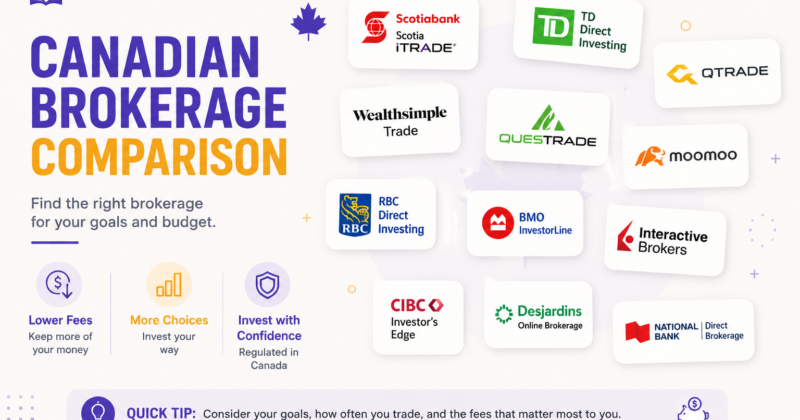
Most major banks offer FHSAs, as do credit unions and online brokerages. The right choice depends on what you want to do with the money inside the account.
If you want to invest in ETFs and keep costs low, Wealthsimple and Questrade are two of the most popular options for self-directed Canadian investors. Both offer FHSAs and let you buy ETFs without paying commissions on purchases.
If you want a simpler, more hands-off experience where someone manages the investments for you, the major banks (RBC, TD, Scotiabank, BMO, CIBC, National Bank) all offer FHSAs with managed portfolio options.
Whatever you choose, the most important step is simply opening the account. The room accumulates from day one.
Quick reference: FHSA facts for 2026
| Detail | Rule |
|---|---|
| Annual contribution limit | $8,000 |
| Lifetime contribution limit | $40,000 |
| Maximum in one year (with carry-forward) | $16,000 |
| Contribution deadline | December 31 |
| Tax on contributions | Deductible |
| Tax on growth inside account | None |
| Tax on qualifying withdrawal | None |
| Repayment required after withdrawal | No |
| Maximum participation period | 15 years or age 71, whichever comes first |
| If you don’t buy a home | Transfer to RRSP or RRIF tax-free |
If this answered your questions about the FHSA, share it with someone who’s been putting off opening one. The account costs nothing to open and the room you lose by waiting cannot be recovered.
Disclaimer: This post is for educational purposes only and does not constitute financial, investment, tax, or legal advice. Rules and contribution limits are current as of 2026 and are subject to change. Always verify details with the CRA and consider your personal situation before making financial decisions.